
Martin Scorsese is a master of cinema and he’s done a lot to preserve films and champion them. Scorsese has been directing movies for fifty years. His career includes 26 feature-length films, seventeen documentaries and one co-directed anthology film. Many of his works are meditations on the evil and cruelty of man. There’s an echo of his Catholic upbringing in his depictions of men struggling and failing to redeem their blackened souls. He’s cowritten with Eric Roth, the screenplay for “Killers of the Flower Moon” based on the 2017 novel, Killers of the Flower Moon: The Osage Murders and the Birth of the FBI, written by David Grann.
It’s an epic film about a tragedy buried in time. Often referred to as the Osage Reign of Terror, as if the Osage Nation was to blame for the heinous crimes they suffered, there’s little evidence of this true story in history books. “Killers” runs three and a half hours. There seems to be an assumption that an important film must be a ponderous opus. This is an epic subject that deserves the big budget treatment, but it could’ve been shorter and would’ve had a bigger impact had it screened with an intermission.
Scorsese is an older white Italian American man. I spent much of the film thinking about how a Native American woman with ties to the Osage Nation would’ve directed this film. Would it still feel like a gangster film overlaid with a western? Would it need to show so much violence–especially against all the women? Scorsese and his phenomenal artistic team have brought to life this period; 1920’s Oklahoma on the Osage Nation Reservation. Scorsese did his due diligence in seeking out members of the Osage Nation to get his depictions on screen as authentic as possible, but he still brings his own viewpoint as a white man. The movie script differs from the book and the film has a different resonance with the focus on the Osage and the Hale family, and less on the FBI.

There are many powerful scenes when you can sense that everything has coalesced: story, acting, production design and music united to bring Scorsese’s vision to life. When Robert De Niro’s character, William “King” Hale, has decided to burn his property down to collect the insurance money, the figures working amongst the flames recall paintings depicting tortured souls in hell (like Renaissance painter Bosch). It’s a surreal moment revealing the true nature of this evil character.
In “Flowers”, the central character is the returning Civil War soldier, Ernest Burkhart, searching for solace. He wants to make a home and establish his place in the world. Leonardo DiCaprio embodies Ernest with sorrow. He furrows his brow, juts out his chin and slumps his shoulders. He portrays a simple man who’s seen awful things and lived to tell of it. He’s easy prey for his uncle, King. He craves recognition almost as much as he lusts for money, women, and booze.
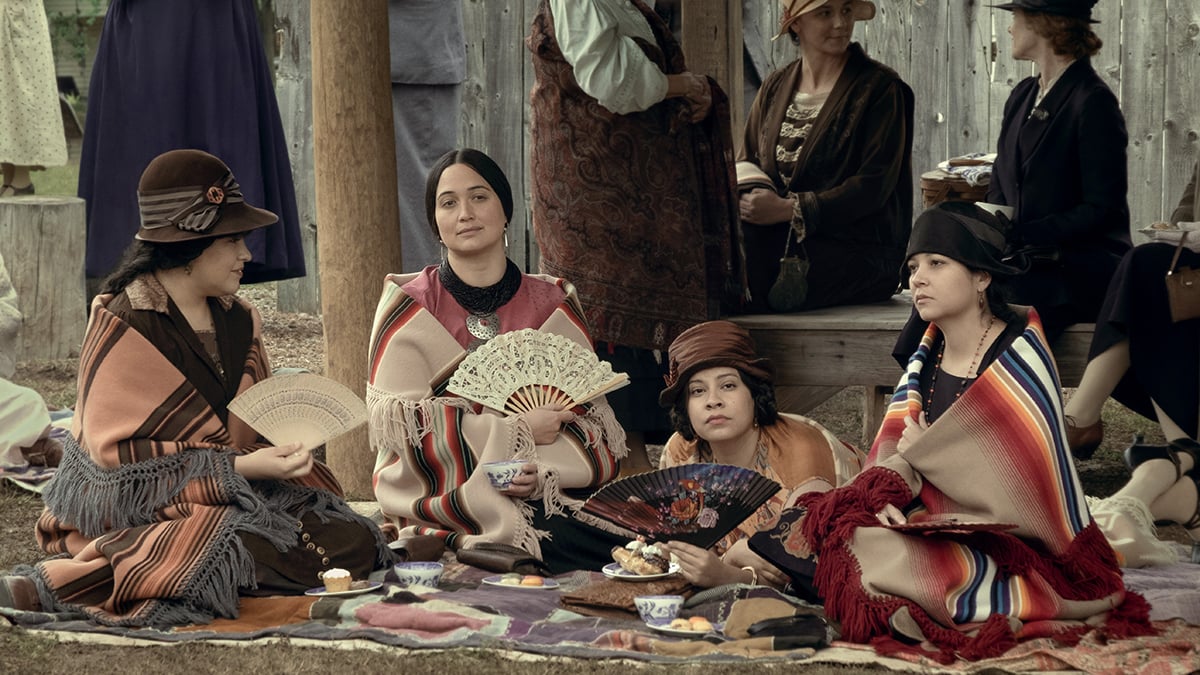
The fascination is watching his character fall in love and begin to make a life for himself while still being under the watchful eye and stern command of his uncle. From the moment she appears on screen, Lily Gladstone wears her Indian blanket like a regal mantle. Molly is self-assured and it’s through her eyes that we see the richness of the Osage life. She and her sisters and mother are close and share a sense of humor and wariness about these white men. Molly calls Ernest a coyote. She knows he’s after her money, but she also finds him attractive.
Her performance is riveting. She’s suffering from diabetes but after marrying Ernest, she seems to wither away. Ernest has been directed by his uncle to orchestrate the deaths of her family so that they can have access to the wealth acquired by the oil discovered on the reservation. DiCaprio and Gladstone brilliantly capture the love the characters feel for each other. Molly trusts Ernest and knows that he’d never hurt her or her family.
What makes the film riveting is how Scorsese lays out the banality of evil at play. William “King” Hale is called the King of the Osage Hills. He’s the benevolent overlord in this community. He donates money to help solve the very murders he’s orchestrating. He endows a dance school while plotting to murder his cronies. King is shown kissing Molly’s head and singing Indian benedictions while supplying the poison that is slowly killing her.
Ernest is under the illusion that somehow, he will save his wife and family. Yet he believes that his uncle is correct in his assumption that as a white man, he’s superior and is therefore entitled to take this wealth. The murders are simply moving along God’s work. These savages would’ve died eventually, and the money was always going to be controlled by white people. When Ernest finally confesses his involvement in these heinous crimes, he cannot reveal to Molly that he knew he was poisoning her. He cannot believe it himself.
Robert De Niro, in his 20th film with Scorsese, gives King the quiet force of complete confidence. He’s certain he’s in the right and feels justified in his evil machinations. His interactions with his nephew and the community show outward benevolence because he believes in his superiority. It’s Molly that breaks your heart. She’s let love blind her wise eyes and Gladstone gives an outstanding performance. I saw her in “Fancy Dance” (2023), a lesser film that premiered at the Sundance Film Festival this year. She gives another spellbinding turn in that film. Lily Gladstone is the reason to see this film.
Drinks with Films rating: 3 1/2 shots of superior whiskey sipped during a storm, while wearing an Indian blanket (out of 5)

 Drinks with films