
” The Color Purple” has had quite the journey. From a book, that was adapted into a film, to a revisioning as a Broadway musical, then a revival, and finally, we have our current iteration, a bold new Hollywood Musical film. In 1982, Alice Walker’s book, The Color Purple, became an almost instant success. The novel won the Pulitzer Prize for Fiction and the following year, Steven Spielberg quickly adapted it into a hit film.
Alice Walker initially hesitated to give up the rights for a film adaptation – Hollywood has a history of lackluster portrayals of African American women. Walker also worried that a crucial love story would be lost. The book makes it clear that Celie and Shug Avery, the nightclub singer, share a romantic relationship and she feared that would be lost.
The film adaptation, “The Color Purple” was released in 1985 and was a critical and financial success. Nominated for eleven Academy awards (among many other accolades), Whoopi Goldberg won Best Leading Actress at the 1986 Golden Globes for her role as Celie. The film does justice to Alice Walker’s book but as she feared, the relationship between Celie and Shug (Margaret Avery) is toned down. There is a shared kiss, but the film portrays their relationship as more one-sided; a crush that Celie feels. Shug’s primary interest in her male consorts.
The new big screen version of “The Color Purple” has been masterfully transformed yet again. Director Blitz Bazawule and screenwriter Marcus Gardley did more than adapt the stage musical (book by Marsha Norman). The 2005 Broadway play was almost entirely sung, as was the revival in 2015. The film isn’t a strict re-creation of the stage show. Nearly two dozen Broadway songs are missing from the movie, replaced with either spoken dialogue or fresh tunes.
“My intent was never just to remake the Broadway play,” director Blitz Bazawule says. “It was more about asking ourselves, ‘What new could we bring to this brilliant canon?’ ” The Color Purple” Biggest changes from the Broadway musical and Steven Spielberg movie, Patrick Ryan, USA TODAY, Jan 2, 2024

There are many changes that Bazawule and Gardley made that bring a fresh perspective to this much-loved classic. The “American Idol” winner, Fantasia Barrino who starred in the 2005 stage musical, plays Celia again in this version. Now, she gets to sing songs that give voice to Celia’s yearnings and her desire to be reunited with her children. There’s more time given to developing her relationship with her dear sister, Nettie (charmingly played by singer/actor Halle Bailey), including an uplifting duet that helps alleviate the challenging storyline.
There’s still a central plot point of ongoing incest. In this version, we learn that Celia’s father is her stepfather, not her father. It’s not much of a difference–it’s still abuse, it’s still rape–but a blood relation seems even worse somehow. This “Color Purple” also gives both the characters, Mister and Shug, some redemption. Mister (Colman Domingo) gets to apologize and works to reunite Celie with Nettie by selling his land. Shug gets to find forgiveness from her father, the pastor.
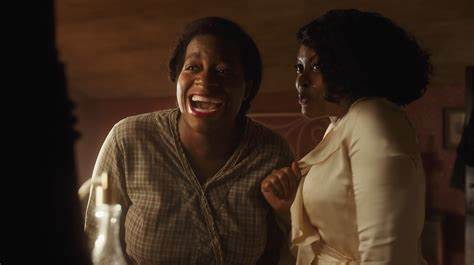
Barrino is starring in her first film here. That shows in her broader expressions and movements, she seems to be playing to the back of the house at times. That works in the musical numbers, but there’s less subtly to her performance. It serves the film to have her appear meek and muted, her spirit beaten into submission, next to the powerful performances of Taraji P. Henson as Shug and Danielle Brooks as Sofia. Henson is radiant as our confidant songstress and there’s no doubt in this version; Shug returns Celia’s love. They have a duet together proclaiming their love and wake up in bed together.
It’s hard to forget the powerful performances of Whoopi Goldberg and Oprah Winfrey in the earlier film but they get to return in this film. Goldberg has a tiny part as the midwife delivering Celie’s baby and Winfrey has a larger role as a Producer with Steven Spielberg and others. Author Alice Walker gets an Executive Producer credit. Danielle Brooks does a great job at portraying the fiery Sofia who suffers an awful beating and then must submit herself to working for her tormentor.
The best part of this new adaptation is the choreography. The dancing, in addition to the sets and costumes, bring a liveliness and depth to the story. As Celie finds herself overwhelmed with desire for Shug, the scene transforms into a bubble bath rotating on a phonograph record. Celia has been transported and the setting and music telegraph her feelings. When the characters aren’t in motion, the action can feel rather staged, like the gathering around the tree at the end of the film. The artifice of singing to communicate a story seems easier to believe if there’s dance or motion with the songs. Though I’m not a big fan of musicals, I believe Alice Walker must be pleased with this bold new version of her cherished novel.
Drinks with Films rating: 2 shots of moonshine at a bayou juke joint (out of 5)

 Drinks with films